
Relaunch!
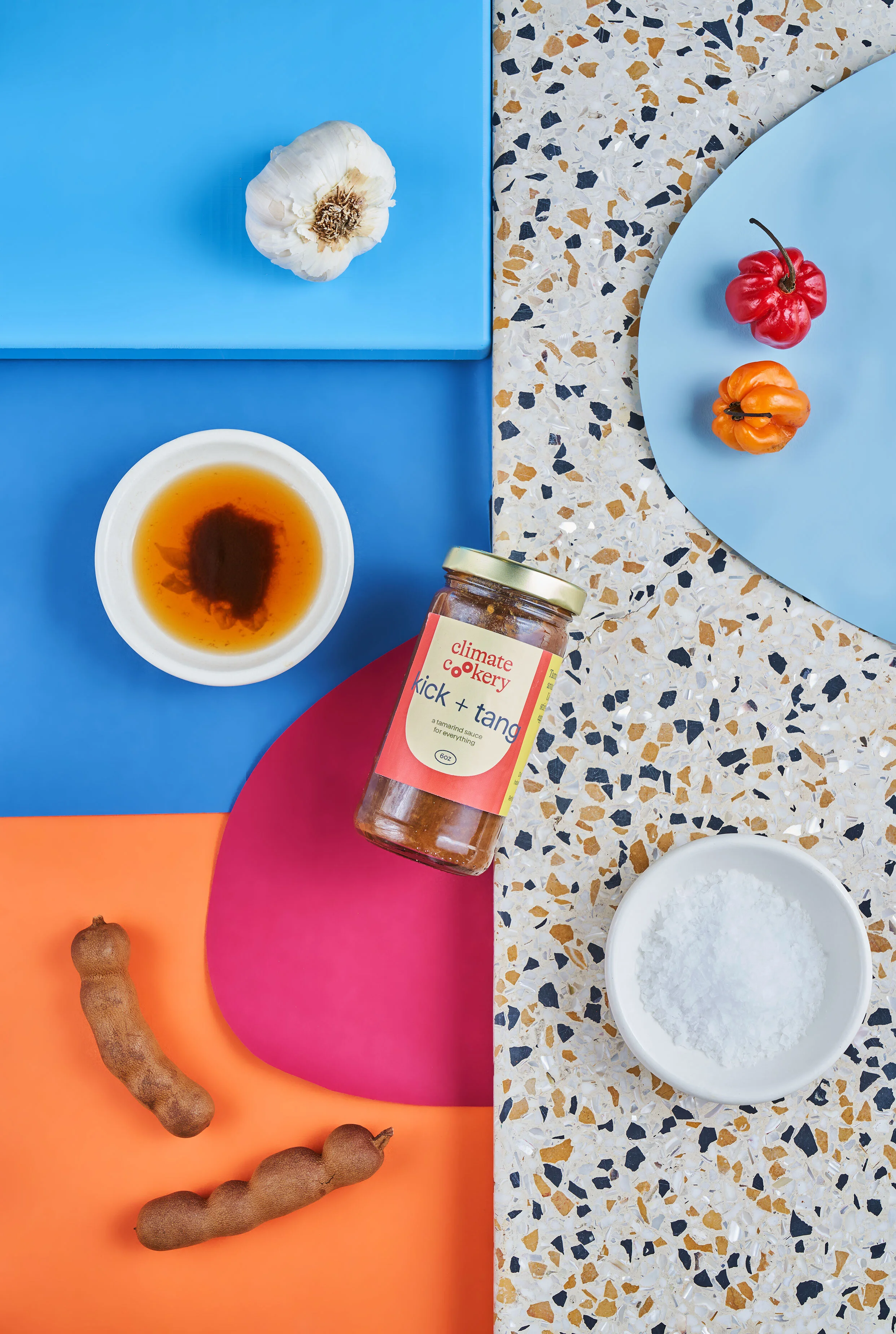
Most of you know Climate Cookery via Kick+Tang, a fiery tamarind hot sauce. Perhaps you bought some? Perhaps you dolloped it on your salads, stirred it in your stir-fries, slathered it on your wings or corn on the cob? Perhaps (if I may be so bold) you felt a bit of disappointment when you reached the end of the jar?
If this describes you – you’re in luck! I’m resuming production of Kick+Tang soon. Click here to support Climate Cookery’s relaunch and get a jar for yourself.
It’s a tough time to resume a business called Climate Cookery. All the climate folks say we should talk about climate change without using the words “climate” and “change.” Everything has somehow gotten even crazier than when I started this business during the pandemic.
My mission is to create modern, delicious foods from the traditional, climate-smart crops overlooked by the industrial food system. Here’s why I think it’s still relevant in this dark Alice-in-Wonderland time we find ourselves in.
Americans look at the state of food around us and we don’t like what we see. We’ve learned or intuit that there are deep structural problems in the way we make, sell and eat food. We’re fed up with the way companies treat us, like we’re pigs willing to eat anything put in our slop buckets.
Tech innovation and merciless marketing work together to create an illusion of abundant choice for what is actually a narrow range of unhealthy foods. Our land is stripped of nutrients, our food is stripped of nutrients, our bodies are stripped of nutrients.
I’ve had multiple people who grew up in other countries tell me that food tastes worse here – a nibble of a strawberry or slice of a leek is less satisfying here than in their country. I’ve noticed it too in my travels. While everything I’ve written about so far makes me feel sad, this last part about food in America tasting unsatisfying, maybe even a little sad — it’s like a punch in the gut. We deserve better.

One small thing we can do about all this is to diversify our diets — to eat a wider variety of foods than we currently do. It’s an act of creativity that can kick off a cascade of benefits for our minds, bodies, each other, the wildlife and the planet.
And there are thousands of disappeared or overlooked foods (known in academic circles as “underutilized crops”) to choose from.
By eating a wider variety of foods, especially ones that are lesser-known and traditional, we can access a wider variety of the nutrients we need to replenish our bodies. We can also create demand for the less commercial but ecologically important crops that demand fewer resources and can help regenerate the soil in which they’re grown – the perennials, the cover crops, even the “weeds.” The foods that will both mitigate and help us adapt to the effects of climate change.
What are some examples? Here are a few currently on my mind:
Eelgrass: I read in Hell Gate recently that conservationists are working to restore New York City’s shoreline with eelgrass, the “unseen plant” that was once found everywhere, and “made possible the legendary footlong oysters and the ecological abundance that used to be New York’s harbor.” On a whim I looked this sea plant up, and as luck would have it, not only does eelgrass help restore coastal wildlife, but it’s also a celebrated part of several indigenous cuisines and offers a high-protein, gluten-free grain source – the “rice of the sea.
Pumpkins: Sometimes these “underutilized” crops are hiding in plain sight. Everyone knows and loves pumpkin, especially this month! But we tend to forget about this vegetable once November 1 rolls around. That’s eleven months of under-utilization of a highly nutritious and climate resilient food – one that grows in drought conditions and even when harvested, lasts for a long time.
Tamarind: This one is always on my mind! Tart, caramel-y tamarind grows everywhere without apology. It needs little water and fertilizers – it just grows on its own. And it's high in fiber and many nutrients, including iron.
In the future, perhaps I’ll sell gnocchi made with eelgrass flour? A savory pumpkin chutney? My dream is this — to create and sell delicious foods from these underdog crops.
But for now, I’m focusing on Kick+Tang.
Moving forward, you’ll see a shift in my newsletter – less of the essay + recipe format of the past, more updates on my business journey and Kick+Tang-specific recipes. I will promote my crowdfund, and eventually my product in general. And some musings on food and sustainability here and there.
If you choose to donate, I’ll share how I use your gift. If you’re on the fence about donating, I’ll make my case (briefly). If you’re waiting to simply buy a jar without donating, I’ll announce locations and times here. And if you just want to keep tabs on Climate Cookery, I got you – I’ll aim for fun, non-heavy lifts in this space, every few weeks or so.
Thank you for your time and I hope you’ll join me on this journey!
